How do you prove 1 million users have $10 billion in deposits without revealing anyone’s individual balance?
You use a Merkle tree.
The same cryptographic structure that secures Bitcoin blocks also powers proof of reserves. It’s how exchanges prove they owe what they claim—and how you can verify your balance is included.
What is a Merkle Tree?
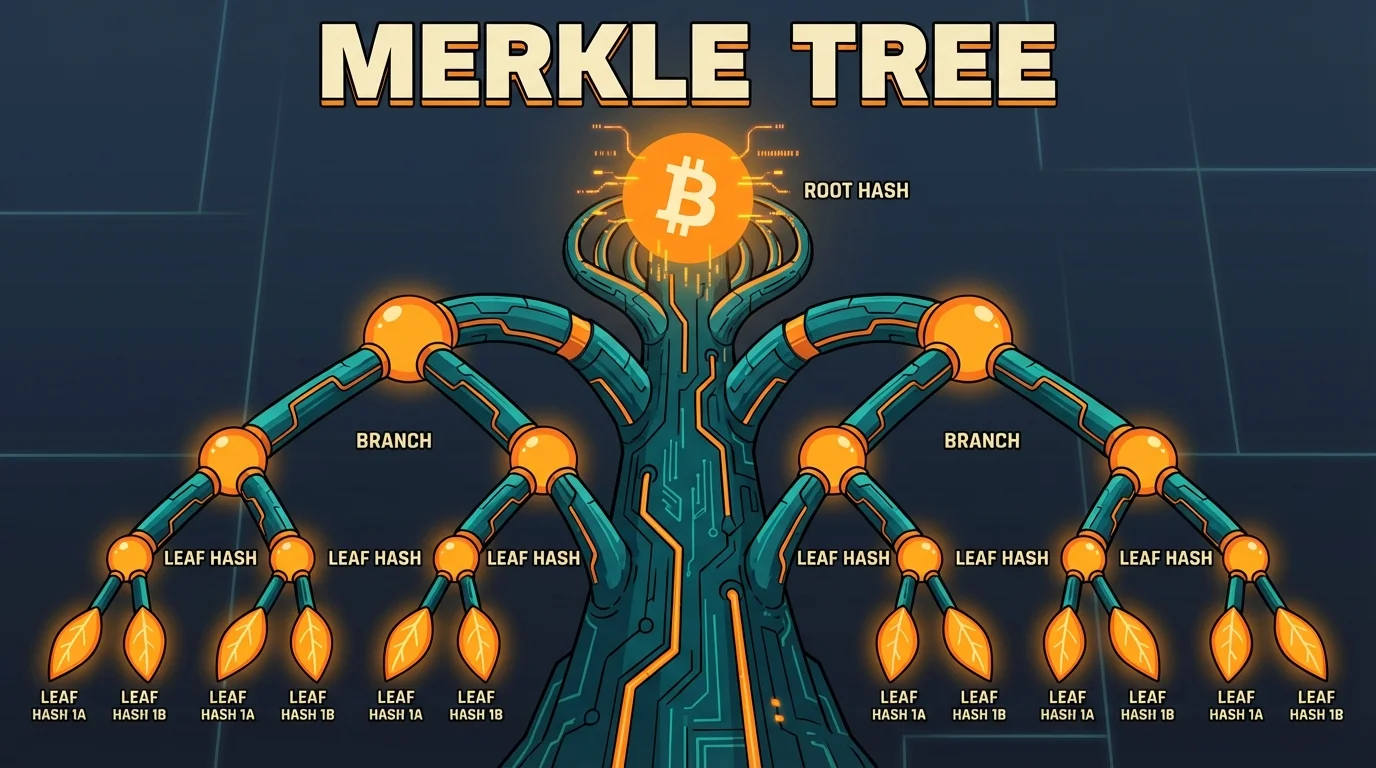
A Merkle tree is a data structure invented by Ralph Merkle in 1979. It organizes data into a tree where:
- Leaves contain the actual data (hashed)
- Branches combine pairs of leaves into new hashes
- The root is a single hash representing all the data
The magic: if any single piece of data changes, the root hash changes completely. This makes it impossible to tamper with data without detection.
Bitcoin uses Merkle trees to summarize all transactions in a block. Git uses them to track file changes. And proof of reserves uses them to summarize all customer balances.
Hash Functions: The Building Block
Before understanding Merkle trees, you need to understand hash functions.
A hash function takes any input and produces a fixed-size output (the “hash”). Key properties:
- Deterministic — Same input always produces same output
- One-way — Can’t reverse-engineer input from output
- Collision-resistant — Practically impossible to find two inputs with the same hash
Example using SHA-256:
"Alice: 1.5 BTC" → a3f2b8c9...
"Alice: 1.6 BTC" → 7d4e9f1a... (completely different!)
How Merkle Trees Work in Proof of Reserves
In a proof of reserves context, here’s how the Merkle tree is constructed:
Step 1: Create Leaves
Each user’s balance becomes a leaf node. The exchange hashes the user ID and balance together:
Leaf_Alice = hash("user_alice" + "1.5 BTC")
Leaf_Bob   = hash("user_bob" + "2.3 BTC")
Leaf_Carol = hash("user_carol" + "0.8 BTC")
Leaf_Dave  = hash("user_dave" + "5.0 BTC")
Step 2: Build the Tree
Leaves are paired and hashed together:
                    [Root Hash]
                    /          \
           [Branch_AB]        [Branch_CD]
            /      \           /       \
      [Leaf_A]  [Leaf_B]  [Leaf_C]  [Leaf_D]
         |         |          |          |
       Alice     Bob       Carol      Dave
       1.5 BTC   2.3 BTC   0.8 BTC   5.0 BTC
The branch hashes combine children:
Branch_AB = hash(Leaf_Alice + Leaf_Bob + sum_balance)
Branch_CD = hash(Leaf_Carol + Leaf_Dave + sum_balance)
Root = hash(Branch_AB + Branch_CD + total_balance)
Step 3: Publish the Root
The exchange publishes only the root hash and total balance. This single value represents all customer liabilities—in our example, 9.6 BTC across 4 users.
Verifying Your Inclusion
Here’s where Merkle trees shine. To prove your balance is included, you don’t need to see everyone else’s data.
You receive a Merkle path—the minimum set of hashes needed to reconstruct the root from your leaf.
Example: Alice Verifies Her Balance
Alice wants to verify her 1.5 BTC is included. The exchange gives her:
- Her leaf data:
user_alice+1.5 BTC - Bob’s leaf hash (not Bob’s actual data)
- The
Branch_CDhash
Alice can now compute:
1. Hash her own data → Leaf_Alice
2. Combine with Bob's hash → Branch_AB
3. Combine with Branch_CD → Root
If her computed root matches the published root, her balance is included. If it doesn’t match, something is wrong.
Alice never sees Bob’s actual balance. She only sees a hash. Same for Carol and Dave. Privacy preserved.
Privacy Preservation
Merkle tree proofs protect user privacy in several ways:
- You only see your own data — Your balance and Merkle path
- Other balances are hashed — Impossible to reverse-engineer
- Tree structure obscures patterns — Can’t determine total user count easily
However, some metadata leaks are possible. An attacker who obtains multiple Merkle paths could potentially deduce information about tree structure and estimate total users.
Limitations of Merkle PoR
Merkle trees are powerful but not perfect:
- Only proves liabilities — Doesn’t prove the exchange has matching assets
- Negative balances can be hidden — Malicious tree construction can hide debts
- Snapshot timing — Only valid at moment of creation
- Trust in construction — Users must trust the exchange built the tree correctly
For a complete picture, Merkle tree proofs should be combined with on-chain asset verification.
zk-SNARKs: The Next Evolution
Zero-knowledge proofs (specifically zk-SNARKs) address some Merkle limitations. Binance pioneered this approach:
- Prove solvency without revealing individual balances
- Cryptographically guarantee no negative balances
- More privacy-preserving than standard Merkle proofs
The trade-off: significantly more technical complexity.
Who Uses Merkle Tree PoR?
Major exchanges implementing Merkle tree proof of reserves:
| Exchange | Implementation | Verification |
|---|---|---|
| Binance | Merkle + zk-SNARK | User-verifiable |
| OKX | Standard Merkle | User-verifiable |
| Kraken | Merkle with auditor | Third-party verified |
| Bitget | Standard Merkle | User-verifiable |

Built BitcoinCompanies so my kids can learn Bitcoin on a map full of 🐉 🐋 🐳 🦈 🐬 🐙 🐠 🦀 🦐.
Turns out adults like it too.