47 exchanges now publish proof of reserves. Only a handful use independent auditors.
After FTX collapsed with “customer funds” that didn’t exist, the crypto industry scrambled to prove solvency. Some exchanges hired auditors. Others built dashboards. Most did the bare minimum.
Here’s how to tell the difference—and which auditors and tools actually matter.
For serious PoR, use The Network Firm (auditor) + Merkle tree verification. For DeFi, integrate Chainlink PoR. For Bitcoin-only, use Bitcoin Companies real-time xpub verification.
The PoR Audit Landscape
The crypto auditing world changed overnight in November 2022. Before FTX, getting a proof of reserves attestation was relatively straightforward. A handful of accounting firms—led by Armanino—had built practices around verifying crypto holdings.
Then FTX proved that point-in-time attestations mean nothing if a company is actively committing fraud between audits.
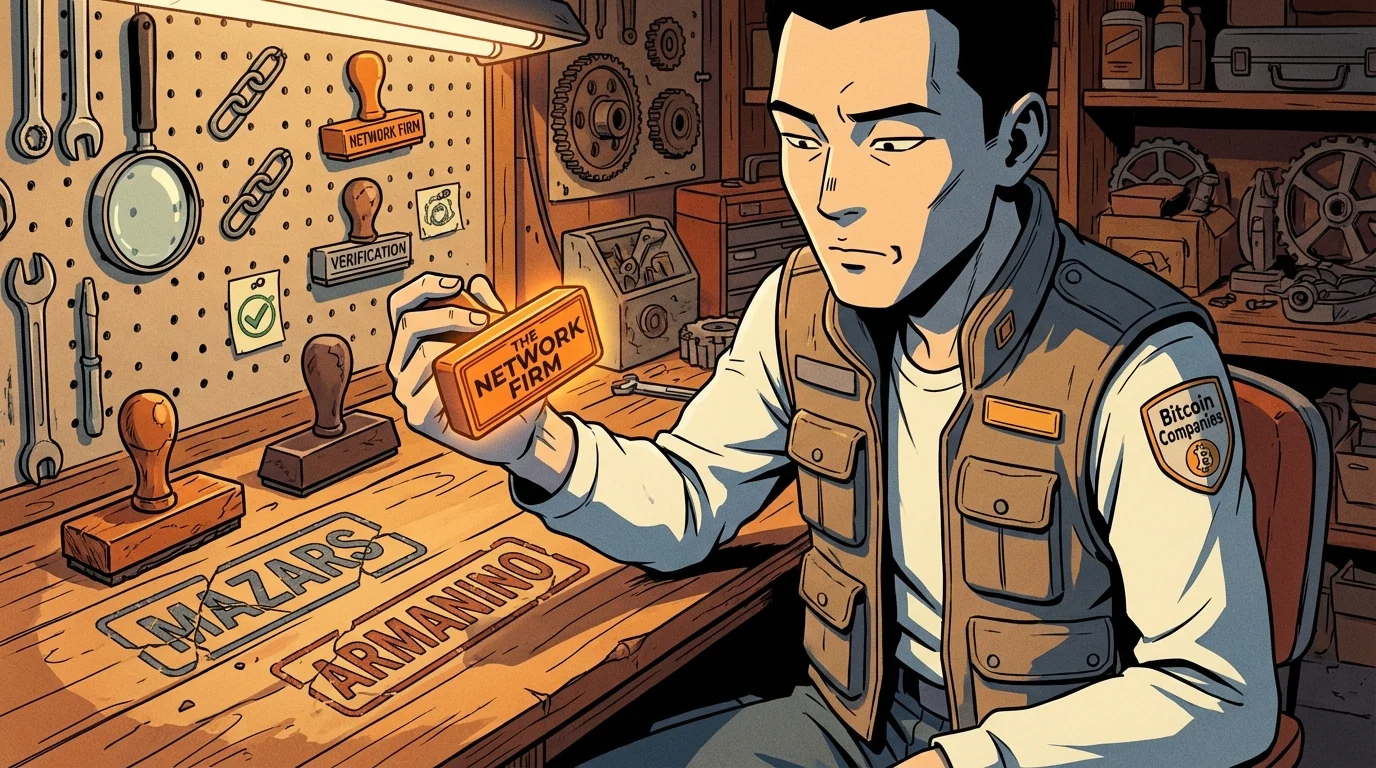
The result: Armanino and Mazars both retreated from crypto auditing, leaving a gap that crypto-native firms rushed to fill.
| Type | Examples | Pros | Cons |
|---|---|---|---|
| Traditional Firms | Mazars, Grant Thornton | Established reputation | Limited crypto expertise |
| Crypto-Native | The Network Firm | Deep blockchain knowledge | Smaller, newer |
| Self-Attestation | Most exchanges | Fast, cheap | No independence |
Top Proof of Reserve Auditors
The Network Firm ⭐
Verdict: Best choice for exchanges serious about PoR
The current leader in crypto PoR auditing. The Network Firm took over Kraken’s proof of reserves after Armanino’s exit.
| Attribute | Details |
|---|---|
| Specialization | Crypto-native, founded for digital assets |
| Notable clients | Kraken |
| Approach | On-chain verification + liability attestation |
| Best for | Exchanges wanting gold-standard verification |
Armanino LLP
The pioneer—now mostly out of the game
Armanino built TrustExplorer, a real-time reserve tracking platform, before scaling back post-FTX. They defined the standards most PoR implementations follow today.
- Status: Limited crypto work
- Legacy: Created the PoR template
- Cautionary tale: Was FTX’s auditor
Mazars Group
Traditional accounting, paused crypto work
Worked with Binance and Crypto.com before pausing in December 2022. Their reports were criticized for not verifying liabilities.
- Status: Paused crypto audits
- Issue: Proved assets but not that they exceeded debts
Grant Thornton
Traditional “Big 4 adjacent” firm with limited crypto exposure. Not a specialist.
PoR Technology Providers
Beyond auditors, technology can automate verification:
Chainlink Proof of Reserve

How it works: Chainlink nodes monitor reserve addresses and publish balances on-chain. Smart contracts check these values before allowing mints.
| Feature | Details |
|---|---|
| Type | On-chain oracle |
| Best for | DeFi, wrapped assets, stablecoins |
| Integration | Smart contract native |
| Website | chain.link/proof-of-reserve |
BitGo
Custody provider with built-in PoR capabilities. Institutions using BitGo can generate segregated, verifiable reserve reports.
Best for: Institutional custody clients who want PoR bundled with custody.
Hoseki
Real-time Bitcoin verification—the future of PoR
Addresses the key weakness of traditional PoR: point-in-time snapshots. Hoseki provides continuous verification.
| Feature | Details |
|---|---|
| Focus | Bitcoin-only |
| Update frequency | Real-time |
| Best for | Bitcoin treasuries, custody |
Self-Service PoR Tools
For smaller companies or DIY implementation:
| Tool Type | Use Case | Complexity |
|---|---|---|
| Merkle tree generators | Liability proofs | Medium |
| Address signing scripts | Prove wallet ownership | Low |
| Open-source implementations | Reference code | High |
For technical details, see our guide to Merkle Tree Proof of Reserves.
Evaluating a Proof of Reserve
Not all PoR implementations are equal. Here’s the checklist:
Gold Standard Criteria ✅
| Criteria | Why It Matters | Weight |
|---|---|---|
| Third-party attestation | Independent verification | Critical |
| Liability inclusion | Proves solvency, not just assets | Critical |
| User verification | You can check your own balance | Important |
| Frequency | Harder to hide short-term fraud | Important |
| On-chain proof | Public, verifiable | Nice to have |
Red Flags 🚩
If you see these, be skeptical:
- PoR shows only assets (not liabilities)
- Point-in-time only, no regular updates
- No third-party involvement
- Users can’t verify their inclusion
- Vague methodology
Current PoR Rankings
Based on Nic Carter’s evaluation—the closest thing to an industry standard:
| Rank | Exchange | Highlights |
|---|---|---|
| 🥇 | Kraken | Third-party audited, user-verifiable, regular updates |
| 🥈 | BitMEX | Comprehensive on-chain verification |
| 🥉 | OKX | Merkle tree with user verification |
Cost & Implementation
Planning your PoR budget:
| Component | Cost | Timeline |
|---|---|---|
| Third-party audit | $50K-$200K/year | Quarterly |
| Merkle tree setup | $20K-$50K | 2-3 months |
| Ongoing maintenance | $5K-$15K/month | Continuous |
| Real-time monitoring | $10K-$30K/month | 1-2 months |
Costs vary by exchange size and asset diversity.
Choosing the Right Approach
| Company Type | Recommended Stack |
|---|---|
| Large exchanges | The Network Firm + Merkle tree + on-chain attestation |
| Medium custodians | BitGo custody with built-in PoR |
| Bitcoin-focused | Hoseki real-time + public addresses |
| DeFi protocols | Chainlink PoR in smart contracts |
See which companies have verifiable proof of reserves on our Bitcoin Companies Leaderboard. All holdings verified on-chain.

Built BitcoinCompanies so my kids can learn Bitcoin on a map full of 🐉 🐋 🐳 🦈 🐬 🐙 🐠 🦀 🦐.
Turns out adults like it too.